Research analysis
Semaglutide event clocks
Why episode clocks and reported experiences need separate measurements.
Published · 13 minute read
How long an episode lasts is a different question from how a person feels throughout treatment. Both involve time, but they require different observations. A duration estimate becomes scientifically useful when its clock, endpoint, and unit of analysis are clear. Without those definitions, a precise-looking summary can be given a meaning its underlying records cannot support.
This article develops the measurement questions behind an episode-duration figure. The central issue is how to connect an event with a person without confusing their timelines, and how to study food-related thoughts as a separately defined experience. The distinction matters before selecting a statistical method, because no method can recover a construct that the observations do not represent.
Wide tables scroll: focus a table and use arrow keys.
Key points
- Unit of observation
- An episode and a participant require different summaries.
- Clock definition
- Onset, resolution, and observation boundaries determine the time question.
- Distribution summary
- A central duration does not specify tails, intensity, or burden.
- Linked records
- Recurrence questions require episodes connected to people and observation windows.
- Construct validity
- A thought measure needs evidence for its own interpretation.
Figure and data
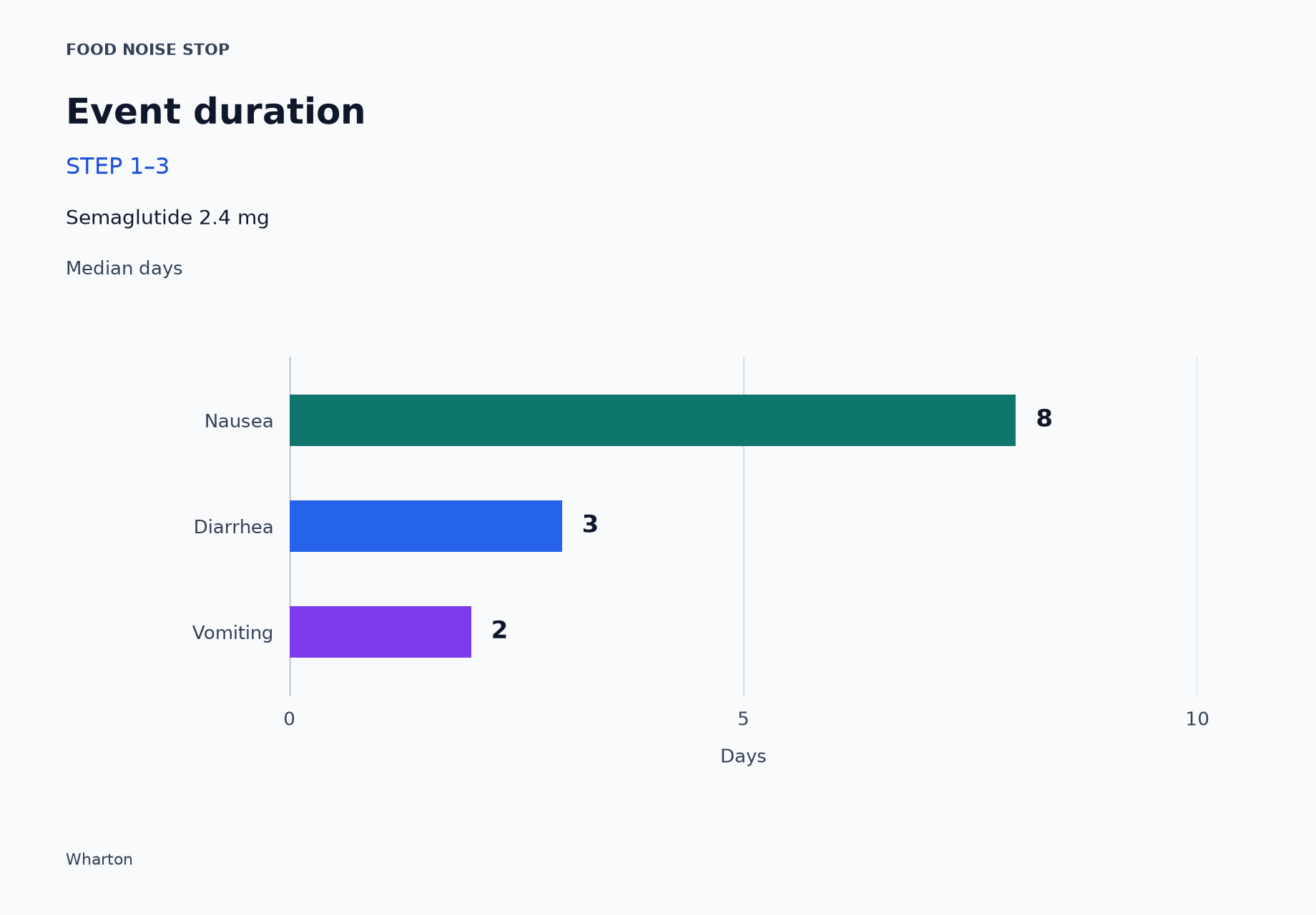
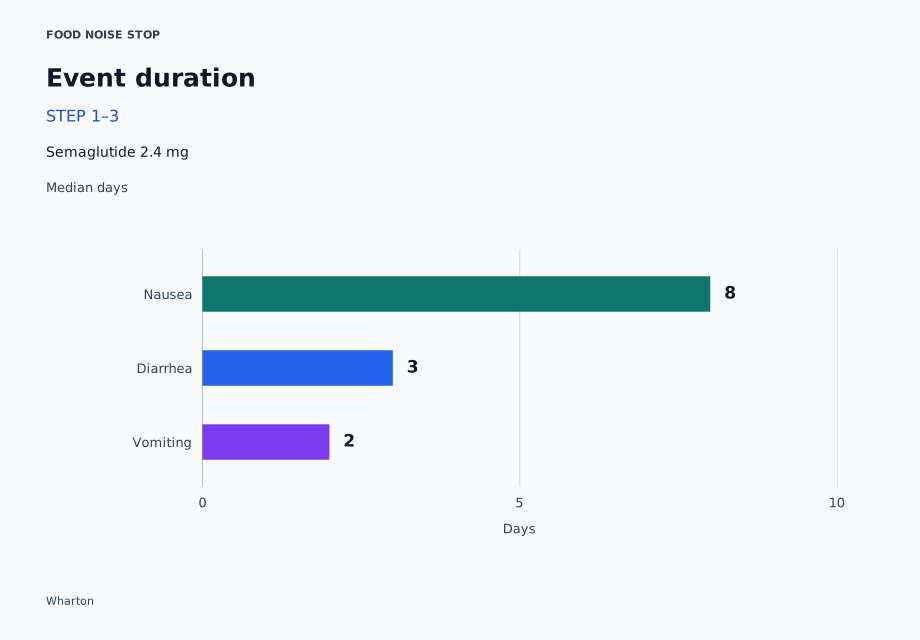
Semaglutide 2.4 mg
Median days
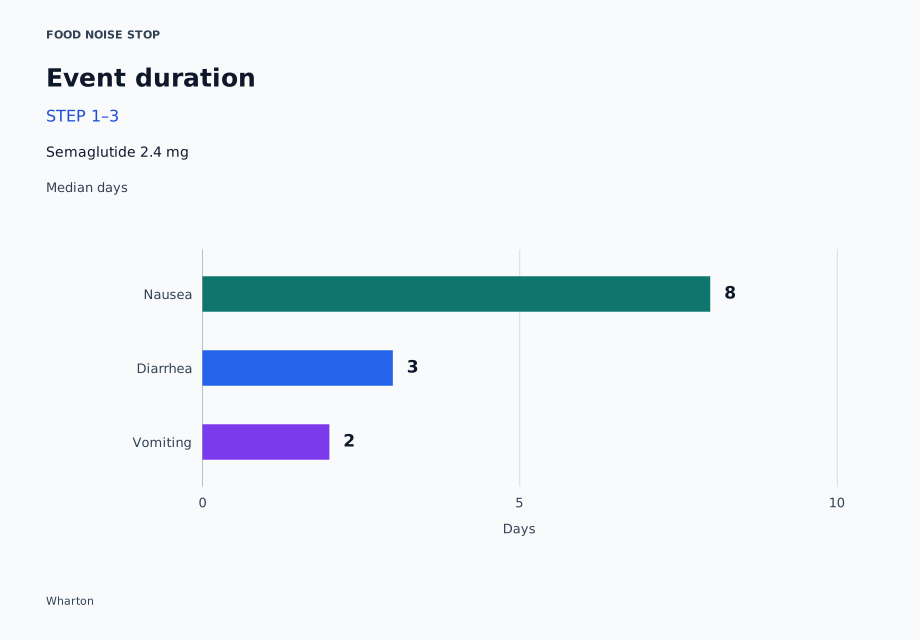
| Event | Days |
|---|---|
| Nausea | 8 |
| Diarrhea | 3 |
| Vomiting | 2 |
Begin with the kind of time being measured
This post hoc STEP 1–3 analysis used 68-week trials of weekly injected semaglutide, target 2.4 mg, in adults with overweight/obesity. Duration estimates used Kaplan–Meier methods; food noise was not an outcome. Novo Nordisk funded trials and editorial assistance; authors disclosed industry relationships.
A duration becomes interpretable when its beginning and ending describe the same kind of occurrence. The unit is an episode with boundaries, rather than a person simply marked as having experienced a symptom. An occurrence indicator answers whether an event was recorded within an observation window. A duration answers how much time separates its defined boundaries. Neither can substitute for the other: recording an occurrence does not supply an ending, and recording an interval does not establish how many people had comparable intervals.
This distinction also frames the science of food noise. A research question about time occupied by food-related thoughts requires a definition of those thoughts and a rule for recording them. A digestive-event clock cannot acquire that meaning merely because both topics concern experiences during treatment. The useful scientific connection is a measurement question: which observations would distinguish an episodic bodily event from an ongoing or recurring mental experience? Answering it starts with separate definitions, before any association is estimated.
An episode clock differs from a life in follow-up
Episode time begins at the onset chosen for that episode. Follow-up time begins at an enrollment, assignment, or other defined reference point. Calendar time locates both within a shared chronology. These clocks can be linked, but their units of observation differ. A person may remain under observation beyond an episode's recorded resolution. Conversely, the observation window may end before resolution is known. Placing an episode on a timeline therefore requires both its own boundaries and the boundaries of the person's observation.
The distinction determines which comparison is meaningful. Comparing episode lengths asks about time to a specified ending among episodes entering the analysis. Comparing time spent with symptoms asks about occupied portions of a person's observation window. Comparing change since treatment assignment asks about a trajectory relative to a shared starting point. Those are different estimands: precisely defined quantities a study aims to estimate. A common time unit does not make the underlying questions interchangeable, because the starting population, counting unit, and endpoint can all differ.
A duration also cannot stand in for how long an effect persists. That question needs an outcome measured repeatedly against its own reference condition. The companion tirzepatide analysis offers a place to examine comparison questions, but a comparison across publications would first require compatible definitions and observation structures. Shared terminology alone would not establish that compatibility or turn separate datasets into a randomized comparison.
What a median retains and discards
A median identifies a central position in a duration distribution. For a time-to-resolution estimand, it concerns when the estimated unresolved proportion reaches its midpoint. That is different from averaging lengths and different from describing the most frequent length. When an estimate incorporates incomplete observation, it need not equal the middle entry in a sorted list of fully observed episodes. Rounding further limits what can be inferred about how recorded durations fall around the displayed value.
The median compresses information deliberately. It does not describe the shape of the distribution on either side, the separation between its central and more prolonged durations, or variation across people. Distinct distributions can share a median while assigning time differently across their tails. A difference between category medians therefore does not establish that every episode in one category lasts longer than every episode in another. Such ordering would require substantially more distributional information than a comparison of central summaries supplies.
Duration and burden are separate even when their temporal units match. Time between onset and resolution does not specify intensity throughout that interval, interruptions to activities, or the amount of attention required. Nor does a central episode length determine the accumulated time a person experiences events. To estimate occupied time, overlapping intervals would need a defined rule so the same stretch of a person's observation is not counted repeatedly. The required data depend on whether the target is episode length, occupied time, or intensity accumulated over time.
| Question | Required observation | Information still missing |
|---|---|---|
| How long does an episode last? | Defined onset and resolution, with incomplete observation identified | Intensity and disruption inside the interval |
| How much time contains events? | Linked intervals within a defined observation window | Whether distinct intervals represent recurrence |
| How does a person experience the events? | Participant-linked observations and a defined burden measure | Meaning of an episode summary for individual experience |
Observation endings change the available information
An observation ending is not necessarily an event ending. If recording stops while resolution remains unknown, the available information may establish that the episode persisted through an observed interval without establishing its eventual length. Right-censoring is the statistical description of that kind of incomplete duration. Treating the last observed date as a resolution date changes the endpoint from a symptom boundary to a recording boundary. Discarding incomplete episodes instead changes which episodes contribute to the analysis.
A survival analysis can retain information from incompletely observed intervals, but doing so does not remove the need for assumptions. The central question is whether the episodes whose later course becomes unobserved can inform the same duration distribution as those that remain observable, under the analysis conditions. Reasons for observation ending matter to that question. Administrative closure and loss of contact are conceptually different processes, although their consequences cannot be decided from those labels alone. The timing and available context would also matter.
Missing onset information raises a separate problem: even a known resolution does not recover an unknown start. Imprecise dates create uncertainty about interval length rather than merely about whether resolution occurred. A well-specified analysis would distinguish these patterns and explain how each affects the estimand. Sensitivity analyses could then examine conclusions under alternative defensible assumptions. This is a proposal for evaluating incomplete measurement, without assigning particular recording rules, missingness patterns, or a direction of bias to the analysis discussed here.
Repeated episodes need a second layer of analysis
Episodes belong to people, so an episode distribution and a participant distribution answer different questions. If people contribute different numbers of recorded episodes, pooling the episodes gives greater representation to those contributing more. A question about the experience of a typical participant requires a participant-level definition instead. Possibilities include accumulated occupied time, recurrence within a common window, or a prespecified summary of that person's episodes. Choosing among them changes the meaning of the result, rather than merely changing its statistical presentation.
The linkage also matters for uncertainty. Episodes from the same person may share recording habits, observation conditions, or other characteristics. Treating them as unrelated observations would require justification. A recurrence analysis would need identifiers connecting episodes to people and a rule separating a continuing episode from a new occurrence. It would also need to account for the time during which another episode could be observed. A count without that observation context cannot distinguish frequent occurrence from a longer opportunity to record events.
Different symptom categories create another linkage problem. Separate summaries do not disclose whether the same people contributed to each category or whether their intervals overlapped. Likewise, comparing food noise and binge eating requires keeping concepts distinct while permitting their observations to be linked. The methodological lesson is not to assume overlap or separation from labels. Joint records are needed to study joint experience; marginal summaries preserve each category's outline while losing information about how categories meet within a person.
Duration does not identify the experience being described
Temporal length, intensity, attention, and disruption are different measurement dimensions. An interval can be precisely timed while the experience inside it remains poorly characterized. An intensity rating adds information about strength, while a disruption question asks about interference with an activity. An attention question asks how prominently something occupies awareness. These dimensions need not use the same response scale or reference period. Combining them without a declared rule produces a score whose interpretation is less clear than the individual observations.
A definition of food noise would need to specify which features of food-related thoughts are intended: their recurrence, intrusiveness, salience, or another clearly described quality. The choice determines what questions belong in the measure. A symptom label cannot answer those questions by proxy. Neither does a change in the amount of eating uniquely identify a change in thought experience. Connecting these observations would require an explicit account of their differences as well as a design capable of measuring their relationship.
The distinction is especially important when interpreting synchronized change. Experiences recorded over the same period may appear to move together, yet a shared time window is not itself an explanatory mechanism. The proposed constructs, their scales, and their temporal ordering must remain visible in the analysis. Otherwise an association can be described using a psychological meaning that the observations never actually captured.
A food-thought measure needs its own definition
Construct validity begins with a claim about what a measure represents. For a food-thought measure, that claim should distinguish ordinary planning or enjoyment from the particular experience being studied. Item wording must then correspond to the defined features. A question about frequency will not necessarily capture unwantedness; a question about interference will not necessarily capture frequency. A total score can be useful only if there is a defensible reason to combine its component responses and an intelligible meaning for change in that total.
The recall window is part of that meaning. A response about the present moment describes a different slice of experience from a retrospective response about a broader period. Repeated assessments can reveal patterns within a person, but they also create recording demands that may affect completeness. A proposed questionnaire strategy therefore needs to connect the intended construct, response format, timing, and acceptable burden. More frequent questioning is not automatically more informative if the resulting observations become selective or lose a stable interpretation.
Evidence for validity would address whether respondents understand the items as intended and whether scores behave consistently with the proposed interpretation. Within-person change and differences between people require separate attention: people can use response categories differently, even when their personal changes are interpretable. Agreement with another measure would be informative only after specifying what agreement should mean and what distinct information should remain. These are requirements for a separate measurement program, rather than evidence that a suitable instrument or a psychological treatment outcome has already been established.
Design a study that keeps the measurements separate
A future paired design should define its questions before selecting an analysis. If the question concerns whether digestive experiences and food-related thoughts vary together within people, both need measurements attached to a shared chronology. The symptom record would require episode boundaries and participant linkage. The thought measure would require its own construct definition and sampling schedule. Prespecified windows would explain which observations can be paired and prevent an investigator from choosing the most favorable alignment after seeing the results.
A food-thought diary could provide one recording format, but the format itself would not establish validity or causal identification. The design should specify what happens when an entry is missing, when a symptom interval spans several entries, and when a thought rating summarizes a period extending beyond an episode. These are alignment questions. Treating each rating as though it described the entire episode would silently replace the rating's actual reference period with a different one.
Analysis would also need to separate variation within a person from variation between people. A person with generally higher ratings is not equivalent to a period when that same person's rating rises. Depending on the estimand, an analysis might summarize personal trajectories or examine aligned deviations while recognizing repeated observations. The choice should follow the research question, with uncertainty reflecting the dependence structure rather than the apparent abundance of individual entries.
Recording reasons for missing observations would strengthen interpretation without guaranteeing that missingness can be corrected. A prespecified strategy should describe which information is needed, what assumptions make the target estimable, and how departures will be explored. Such a design could study temporal associations. A causal question would additionally require a justified comparison structure and assumptions about alternative explanations; collecting paired observations alone would not supply them.
| Proposed record | Purpose | Remaining assumption |
|---|---|---|
| Participant and episode linkage | Distinguish recurrence from contributions by different people | Episode boundaries identify comparable occurrences |
| Onset, resolution, and observation windows | Locate incomplete intervals and establish temporal alignment | Recording boundaries are interpreted consistently |
| Separate experience questions | Measure the defined food-thought construct | Responses support the intended interpretation |
| Missingness reasons and a prespecified estimand | Connect incomplete observations to the analysis target | Required assumptions remain defensible |
The current US label has a separate role
The US Wegovy label warns about severe digestive reactions and dehydration-related kidney injury. It advises against use with severe gastroparesis and tells patients to contact their clinician for severe or persistent digestive symptoms. This brief boundary does not replace the complete label or an individual assessment.
A distribution summary and an individual assessment serve different purposes. The distinction also applies when reading about side-effect management: an episode median does not set a symptom-waiting interval.
Match each conclusion to its observation
A sound interpretation keeps a chain intact: the research question determines the target quantity, the target determines the required observations, and the observation process determines which assumptions are needed. Breaking any link changes what a conclusion can mean. An event-duration summary remains useful for its temporal question even when it leaves participant burden or thought experience unresolved. Its usefulness does not depend on stretching it into an answer to every question readers bring to it.
This also clarifies how to consider GLP-1 explanations. A proposed explanation concerns relationships among defined processes; a measured association concerns relationships among recorded variables. Moving from one to the other requires evidence that the variables represent the processes and that the study design can distinguish competing explanations. A duration summary alone does not provide that bridge. Conversely, failure to measure a construct does not establish that the construct is unaffected. The appropriate conclusion concerns the question's unresolved status.
The next scientific step is therefore to identify the information that would resolve a particular uncertainty. A recurrence question calls for linked episode histories and observation windows. A burden question calls for an explicit rule combining duration with the relevant experience dimension. A food-thought question calls for a separately interpretable measure. Keeping those requirements distinct makes future findings easier to compare, because agreement or disagreement can be traced to a shared question rather than assumed from similar labels.
Questions
What does an event-duration median leave unknown?
It leaves the distribution's tails, individual variability, and experience inside each interval unspecified. Even knowing a central duration does not recover how often episodes recur or how their intervals overlap within people. Those omissions concern different dimensions of information. Resolving them requires additional observations, not a more elaborate verbal interpretation of the same central summary.
Why does the choice of clock matter?
The clock defines the starting point and the endpoint of the quantity being estimated. Time since an episode began describes its course; time since assignment locates a person in follow-up. Aligning these clocks can support a longitudinal question, but replacing one with the other changes the question. A treatment-effect duration would additionally require a defined outcome and comparison over time.
How can repeated events change the question?
Repeated episodes make the connection between observations and people essential. An episode-weighted analysis can emphasize people who contribute more episodes, while a participant-level analysis requires a rule summarizing each person's experience. Neither choice is automatically correct. The intended estimand determines the choice, and uncertainty assessment must recognize that observations linked to the same person may share characteristics.
What would connect symptom records to food-thought measures?
A defensible connection would require shared participant identifiers and compatible recording windows, alongside an independently defined thought measure. The analysis would need to preserve what each record actually covers. Temporal alignment can support a question about association, but it does not establish that a symptom represents a thought experience or that either causes the other.
What information would improve a future study?
Useful additions would be clear episode boundaries, participant linkage, observation windows, reasons for missing records, and a prespecified target quantity. For experience questions, the study would also need evidence that its questions represent the intended construct. These additions serve different purposes: some define time, some support linkage, and others establish meaning. Their value depends on the uncertainty the study aims to resolve.
Assessment
The strongest interpretation preserves the distinction between a timed episode, a person's observation history, and a measured experience. Each requires its own operational definition. Connecting them is possible through deliberate study design, but the connection must be demonstrated rather than supplied by terminology. Clear estimands and linked observations turn an unresolved question into a tractable research problem while preserving the meaning of the evidence already available.
Sources
- Wharton: STEP analysis
Article and supplement.
Checked .
- Rubino: SURMOUNT analysis
Article and supplement.
Checked .
- DailyMed: Wegovy
Current US label.
Checked .
- DailyMed: Zepbound
Current US label.
Checked .