Research analysis
Tirzepatide symptom groups
How later group membership changes the questions a comparison can answer.
Published · 13 minute read
Grouping observations is a scientific choice. A category can make a pattern easier to see while concealing the sequence that produced it. Interpreting a comparison therefore requires asking how membership was determined, what the outcome measures, and which observations remain available for analysis.
The central methods question is how to connect those choices to an answerable question. Treatment effects, associations between experiences, and validation of an indirect measure require different evidence. Keeping them distinct makes it possible to identify what a future study would need to observe.
Wide tables scroll: focus a table and use arrow keys.
Key points
- Assigned treatment
- Random allocation supports an assignment comparison; later classifications need their own justification.
- Later group membership
- A threshold can preserve category membership while discarding changes within a history.
- Outcome scale
- A model-based group summary does not describe every individual path or a response probability.
- Observation window
- Which records remain observable helps determine the question an estimate can address.
- Proxy validation
- An indirect measure needs evaluation against the defined experience for its intended use.
Figure and data
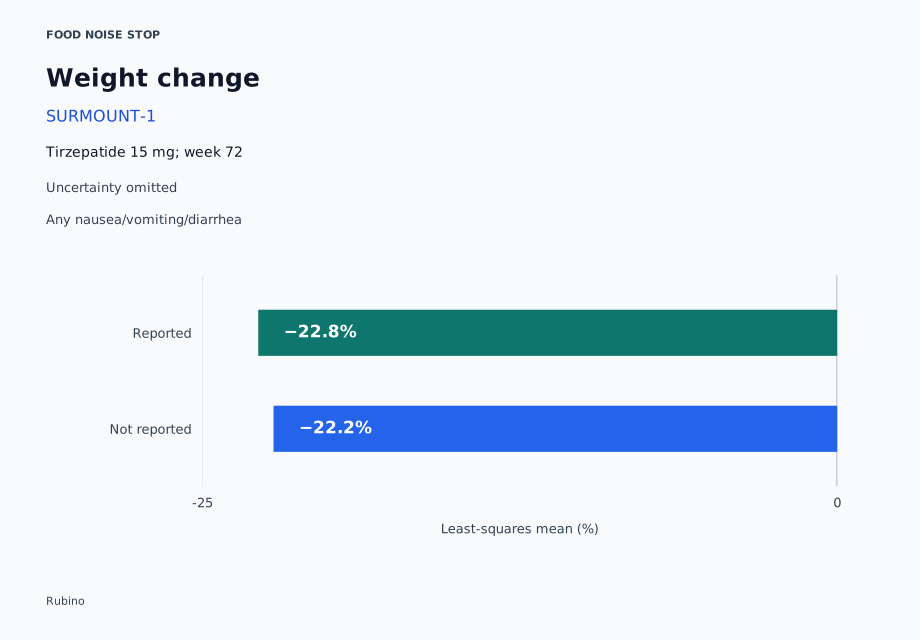
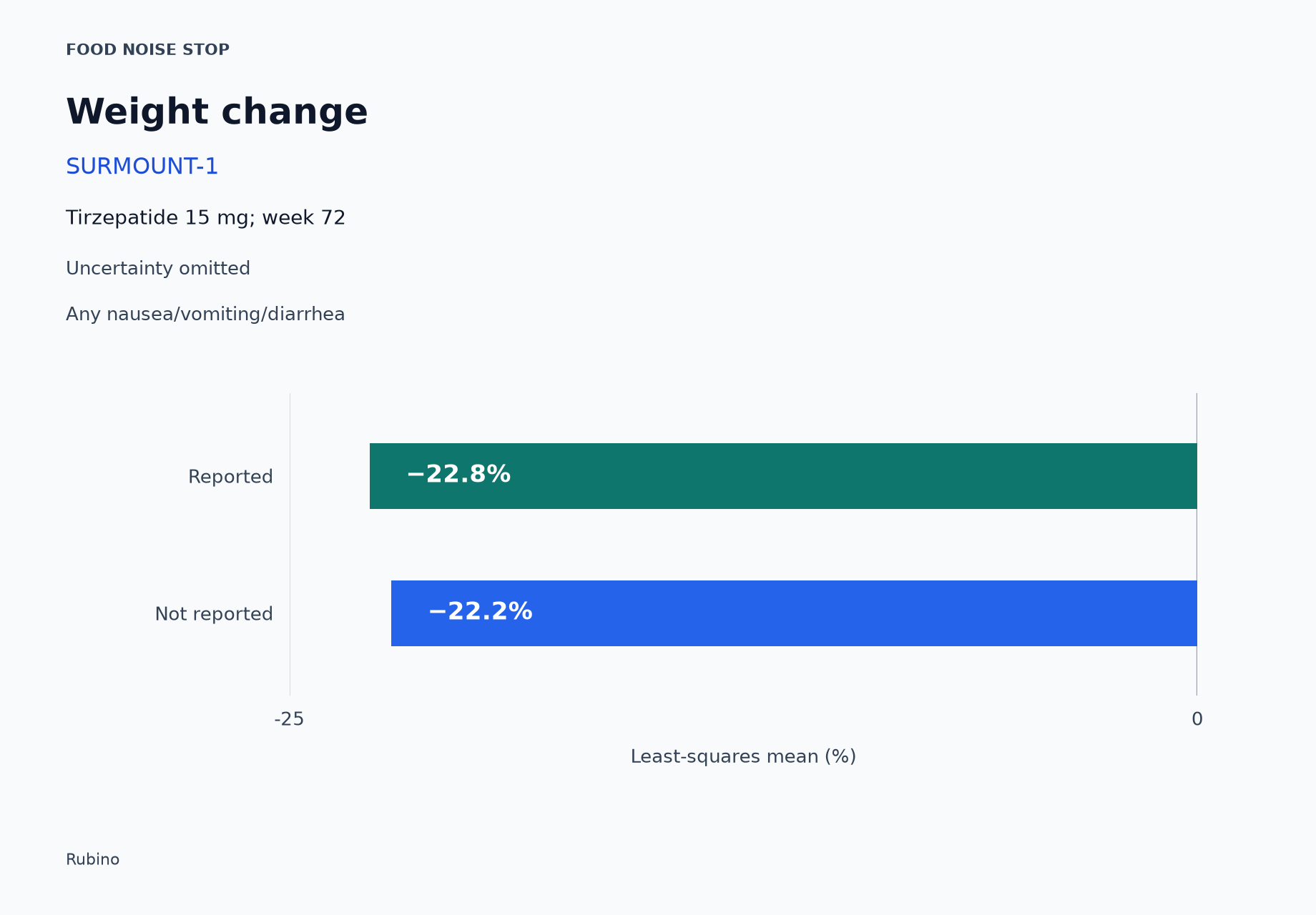
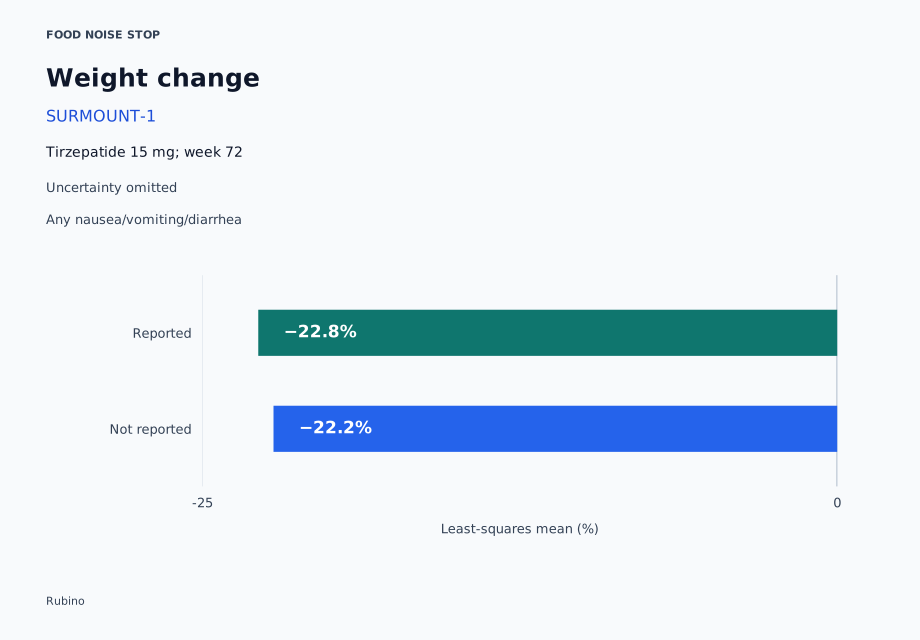
Tirzepatide 15 mg; week 72
Uncertainty omitted
Any nausea/vomiting/diarrhea
| Group | Least-squares mean (%) |
|---|---|
| Reported | −22.8 |
| Not reported | −22.2 |
Start with the observed outcome
SURMOUNT-1 studied weekly injected tirzepatide in adults with overweight/obesity without diabetes. This post hoc comparison uses symptom-defined groups and excludes post-discontinuation data; it did not assess food noise. Lilly funded the analysis; six authors were employees/shareholders.
A measurement begins with an operational question: what property was recorded, over what interval, and in what unit? A change in body mass describes a physical quantity relative to a reference measurement. A report of an experience records a judgment under a reporting procedure. An account of recurring food thoughts would require its own definition, response options, and time frame. These domains can be studied together, but their scales have no automatic conversion. Deciding what food noise means is therefore part of specifying an outcome, before interpreting relationships with other observations.
The useful distinction is between describing a pattern and identifying what produced it. Describing a pattern requires a clear denominator and measurement rule. Explaining it requires a comparison capable of separating competing causes. Validating an indirect measure adds another requirement: evidence that it preserves information about the intended experience. These tasks can build on one another, but success at an earlier task does not complete the later ones. The methods discussion below asks what each representation permits, and what additional observations would make a stronger question answerable.
Treatment allocation does not randomize later experiences
Random allocation concerns the rule used to assign an intervention. It makes the assignment independent of pretreatment characteristics in expectation, allowing a treatment contrast to begin from a defensible comparison. It does not assign the experiences that follow. Sorting people by a later experience replaces the original grouping rule with one involving events along their subsequent paths. The resulting categories can differ for reasons that randomization was never designed to balance within them.
Consider the structure of that problem without assuming a particular biological mechanism. Pretreatment susceptibility could influence both a later report and a later outcome. Observation opportunities could influence whether an experience enters the record. Changes during follow-up could influence reporting and the outcome together. These are possible relationships to investigate, not established explanations of any particular result. Their relevance is that equal treatment assignment does not force equal distributions of such factors among categories defined afterward. Adjustment also needs a rationale: a variable measured later might reflect treatment consequences, so including it can change the question rather than simply improve fairness.
The target comparison should consequently be written before choosing a statistical model. An assigned-treatment effect asks about alternative intervention assignments. A descriptive subgroup contrast asks how recorded outcomes differ across an observed classification. A causal effect of the experience itself would require defining what intervention could change that experience and which other pathways would remain intact. The companion event-duration analysis provides a separate context for thinking about measurement units; moving between contexts does not create a common randomized comparison.
A symptom threshold compresses a history
An ever-event indicator is a compression rule. It maps an entire sequence of observations onto a category determined by whether a threshold was crossed. Once that threshold has been crossed, later entries may leave the category unchanged. That property makes the indicator useful for some descriptive questions, but insensitive to additional information that could matter for another question. Classification stability is therefore not the same as stability of the underlying experience.
Recurrence, intensity, onset, and duration are separate dimensions of a history. An indicator need not preserve their ordering or distinguish isolated from repeated episodes. Nor does a total count necessarily preserve how episodes were spaced. A duration measure adds time information but can still leave intensity unspecified. The appropriate representation depends on the question: frequency concerns recurrence, burden may require duration and intensity, and temporal hypotheses require order. None can be reconstructed uniquely from a compressed category because multiple histories map to the same label.
Observation time is part of the classification opportunity. A longer observable interval offers more opportunities for an event to be recorded, even when the underlying process is unchanged. A proposed analysis should separate that opportunity from the event process and specify how it handles gaps. An unrecorded interval cannot automatically be labeled event-free. Comparing indicator categories without examining observation opportunities risks treating a feature of data collection as a feature of experience. Richer records would allow the analyst to compare alternative representations and learn which distinctions the simpler classification erases.
| Representation | What it retains | What it discards |
|---|---|---|
| Ever-event indicator | Whether a reporting threshold was crossed | Order, recurrence, duration, and intensity within the category |
| Episode sequence | Ordering and recurrence of recorded episodes | Intensity and duration unless separately recorded |
| Duration and intensity history | The timing and magnitude specified by its recording scheme | Unobserved intervals and experiences outside the scheme |
The weight outcome uses a different measurement scale
Percent change expresses a difference relative to a baseline value. The baseline is therefore part of the outcome's meaning, not merely background information. A proportional change and an absolute change answer different questions because they use different scales. The sign describes direction under the chosen subtraction convention; it does not classify the quality of someone's experience. A physical outcome can be meaningful while remaining conceptually separate from a report of thoughts, distress, or daily interference.
A least-squares mean is a summary derived from a fitted model. Interpreting such a summary requires knowing the modeled outcome, the variables included, and the reference distribution used to summarize predictions. It is not necessarily the arithmetic average of all observed changes. It also is not a trajectory that every participant followed. Averaging over people removes information about individual paths; averaging model predictions adds dependence on the model specification. Neither operation produces the fraction of people who meet an individual response criterion. That fraction would require a separately defined threshold and an appropriate person-level denominator.
The apparent spacing between point estimates cannot establish their precision. Precision concerns how uncertain each estimate and the relevant contrast are under the analysis assumptions. Similar positions on an axis also do not establish equivalence, which requires a justified tolerance and an analysis designed to evaluate it. Conversely, a visible difference alone does not explain its cause. Connecting an outcome with food-noise science requires a measurement bridge as well as a statistical comparison. A shared percentage symbol would not supply that bridge if the underlying quantities described different properties.
Conditioning on a later event can change the comparison
Conditioning means restricting or organizing an analysis according to the value of a variable. When that variable occurs after treatment begins, it may carry information about several processes at once. Suppose, as a conceptual structure, both an underlying susceptibility and an observation process influence whether a report is recorded. Restricting attention to a report category can make those contributing factors associated within that category, even if they were independent before the restriction. In causal-diagram language, the report can act as a collider: a common consequence of different causes.
The consequence for interpretation depends on the rest of the causal structure. If a factor involved in that selection also affects the outcome, a subgroup contrast may mix the association of interest with an association introduced by conditioning. This possibility does not show that a particular estimate is biased, establish the direction of any bias, or quantify its size. It identifies an assumption that a causal interpretation would need to address. Drawing competing diagrams is useful because each diagram makes its proposed dependencies explicit rather than burying them inside an adjustment list.
There is also a timing problem in defining groups using information collected across follow-up. A later category can summarize events that occurred after an earlier outcome measurement. The category then cannot simply be treated as an exposure already present at every earlier time. A prospective causal question needs a temporal ordering appropriate to the proposed pathway. Distinguishing food thoughts and eating behavior adds a related discipline: each proposed variable needs its own definition, so the diagram does not quietly substitute an observed behavior for a different experience.
Follow-up decisions shape the estimand
An estimand is a precise statement of the quantity a study aims to estimate. It identifies the population, treatment conditions, outcome, summary, and handling of events that complicate interpretation after treatment begins. Those events can change what an outcome means even when the measurement instrument stays the same. Defining an estimand therefore precedes choosing a convenient set of available records. Otherwise, the answer can drift toward whatever the data happen to contain.
A treatment-policy question concerns an assigned strategy with subsequent treatment changes included in that strategy's consequences. A question focused on experience while treatment continues has a different scope. Removing later observations does not, by logic alone, remove earlier observations from the same participant; record-level inclusion and person-level inclusion are different operations. Likewise, an unobserved outcome is not an observed absence of change. The reasons for missingness matter because an estimate based on observed records may not represent the intended population when observation depends on relevant outcomes or their predictors.
A proposed analysis should state what additional assumptions connect its available measurements to its target quantity. Sensitivity analyses can then vary those assumptions while keeping the target question explicit. Repeating a model under a different observation rule can change both the evidence and the estimand, so agreement between estimates needs interpretation rather than a simple robustness label. This distinction also matters when reading medication comparisons: matching outcome names does not ensure that follow-up strategies, treatment changes, and target quantities match. Comparability must be argued at the level of the question.
A proxy needs validation against the intended construct
A proxy is an indirect measure proposed to stand in for another property. Its adequacy depends on the intended use. An indicator might help predict a broad category while failing to measure the intensity of an experience or its change over time. Validation should therefore start by defining the target construct and the decision the proxy is meant to support. Without that step, a convenient association can be mistaken for evidence that the measures are interchangeable.
Direct joint measurement would be necessary to examine what information the proxy retains. Investigators would need both the candidate proxy and a defensible measure of the target experience collected from the same participants under compatible timing. Questionnaire methods belong at this design stage because wording, recall windows, and response options determine what a score represents. Agreement should be assessed on a scale appropriate to the proposed use; correlation alone describes co-variation and can remain strong despite systematic disagreement. Measurement error in the reference measure also requires attention, since disagreement cannot automatically be assigned entirely to the candidate proxy.
Responsiveness introduces a further test: does within-person change in the indirect measure preserve meaningful change in the intended construct? A relationship across people at a single time does not answer that question. Validation also needs to examine whether the relationship holds across relevant contexts and reporting conditions. Evidence from one setting can support a bounded use without licensing transport everywhere. Finally, proxy validity and causal mediation are separate claims. A useful indirect measurement does not identify a causal pathway, and evidence about a pathway would not by itself establish that a convenient substitute measures the experience accurately.
Pair repeated measures without assuming a mechanism
A prospective study could begin with pretreatment measurement of the intended food-thought construct and clear definitions for each accompanying outcome. Its observation schedule should reflect the temporal question: whether experiences coincide, whether one precedes another, or whether a change predicts a later outcome. These are distinct questions with different timing requirements. A common calendar is helpful, but it cannot recover events occurring between observations unless the recording method captures their timing. Recall windows should therefore be aligned deliberately rather than assumed to be interchangeable.
Event-level records could retain onset, resolution, recurrence, and intensity while participant identifiers connect those records with repeated construct and physical measurements. A food-thought diary is a way to consider the organization of such observations, not proof that a particular instrument is valid. The study would need a defined recording procedure and a way to distinguish a completed event-free report from an unanswered entry. Recording opportunities and gaps should remain visible in the data structure. Otherwise, a later analyst cannot separate an absence of documentation from documentation of absence.
The analysis plan should distinguish between-person differences from within-person changes. Pooling repeated observations without that distinction can mix a stable difference among participants with a process unfolding within each participant. A prediction model would need evaluation on observations kept separate from its development, with performance assessed for its intended use. An association analysis would need an explicit summary and uncertainty assessment. A causal mediation analysis would require additional assumptions about timing, confounding of the relevant pathways, and treatment-related factors affecting both mediator and outcome. Repeated measurements help specify those questions but do not satisfy those assumptions automatically. Prespecifying missingness analyses and competing temporal explanations would make the eventual evidence more interpretable.
| Proposed evidence | Question addressed | What it does not prove |
|---|---|---|
| Direct joint measurement | Does the candidate retain information about the defined construct? | That either measure is error-free or interchangeable |
| Aligned repeated observations | Do changes coincide or follow a specified temporal order? | That temporal order establishes a causal pathway |
| Prespecified missingness analysis | How sensitive is the inference to observation assumptions? | That the reasons for missingness are fully known |
| External measurement evaluation | Does performance persist in the intended new context? | That validity transports to every population or purpose |
The current US label has a separate role
The US Zepbound label warns about severe digestive reactions and dehydration-related kidney injury. It advises against use with severe gastroparesis and tells patients to contact their clinician for severe or persistent digestive symptoms. This brief boundary does not replace the complete label or an individual assessment.
A clinical warning and a measurement-validation result serve different purposes. A precaution cannot calibrate an indirect measure or establish what an unmeasured experience means.
Keep the causal and measurement questions distinct
A useful interpretation keeps the chain of reasoning visible. First identify the measured property and its scale. Then identify how membership in a comparison group is determined. Next specify which observations contribute and which target question that observation rule can address. Only after those steps is it possible to ask whether the recorded measures provide evidence about a different construct. Each link requires its own justification; a persuasive appearance at the end of the chain cannot repair an unsupported earlier step.
This approach separates several questions that otherwise collapse together. A descriptive difference concerns recorded outcomes. A treatment effect concerns alternative assignments. A mediation claim concerns an intervening pathway. A proxy claim concerns preservation of measurement information. Their methods overlap, but their assumptions are not interchangeable. Discussion of how GLP-1s help can motivate hypotheses, while a specific hypothesis still needs an outcome and a design capable of testing it. A broad explanatory account cannot supply missing measurements.
The productive next step is therefore to design the missing comparison, not to give a subgroup summary a broader meaning. Retaining temporal detail, measuring the intended experience directly, and making observation rules explicit would allow competing explanations to be investigated. The strength of an interpretation lies in how closely its question matches those measurements and assumptions, rather than in how simple the resulting graph appears.
Questions
Why is a symptom subgroup different from a randomized arm?
Randomization governs assignment, whereas a later classification depends on what happens after assignment. Factors shaping that later event can also shape the outcome or its observation. A causal interpretation of the resulting contrast therefore needs assumptions appropriate to that new comparison; it cannot inherit all the protection of the assignment procedure.
What does a least-squares group summary represent?
It summarizes predictions from a specified model under a chosen reference scheme. Its meaning depends on the outcome scale and model specification. It does not preserve the distribution of individual trajectories, and it cannot be read as the chance that an individual will meet an outcome threshold. Those are different summaries requiring different information.
Why does a missing symptom report not define another experience?
A missing report is a property of the observation record. Defining another experience requires a measurement rule for that experience. Without such a rule, silence in one part of a dataset cannot be translated into presence or absence in another domain. Even a completed report addresses only the question and interval it was designed to capture.
What would validate a proposed proxy?
Validation would require a defined target, direct joint measurement, assessment of agreement and error, and evaluation of changes over time where that use is intended. It should also examine the contexts in which performance holds. Predictive usefulness alone would not show interchangeability, and interchangeability would not establish a mechanism connecting treatment and outcome.
Which timing information would clarify a causal question?
Investigators would need the ordering of the proposed cause, intermediate experience, and outcome, together with timing of relevant alternative explanations and gaps in observation. Earlier occurrence is necessary for many causal accounts but insufficient to choose among them. Repeated records make temporal assumptions testable in more detail while leaving confounding and measurement validity as separate questions.
Assessment
The strongest methodological account separates compression of histories, selection into later groups, the scale of an outcome, and the process governing observation. Each can alter what a comparison means without changing its visual simplicity. Direct measurement of the intended experience would provide the foundation for evaluating a proposed proxy. Explicit temporal and causal assumptions would then determine whether the study could address prediction, association, or a pathway. These are design requirements, not conclusions supplied by a group summary.
Sources
- Wharton: STEP analysis
Article and supplement.
Checked .
- Rubino: SURMOUNT analysis
Article and supplement.
Checked .
- DailyMed: Wegovy
Current US label.
Checked .
- DailyMed: Zepbound
Current US label.
Checked .